Why No Two Ikat Pieces Are Ever Alike
Industrial production is measured by how perfectly it repeats. Handweaving is measured by something else entirely.
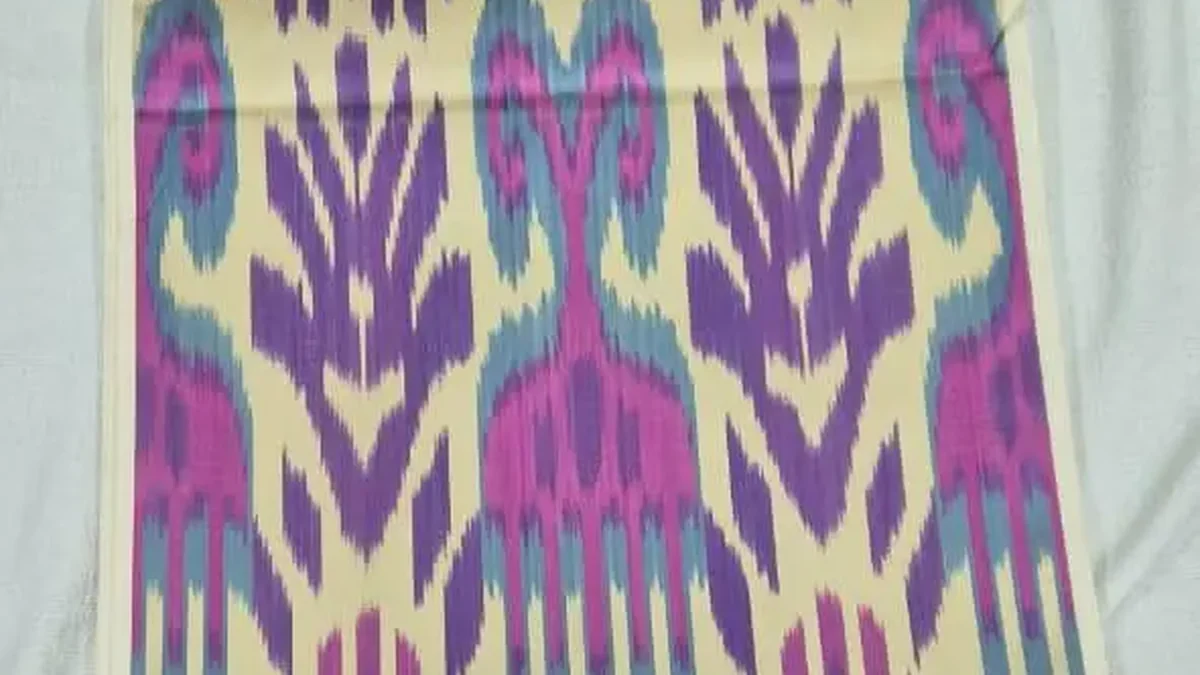
Uniqueness is one of the most overused words in fashion. It usually means a limited run, a numbered label, or a colourway that will not return next season. In ikat weaving it means something stricter: the process itself makes exact repetition impossible.
Where the variation comes from
In ikat, threads are bound in bundles and dyed before weaving. The bound sections resist the dye and stay light; each further colour requires another round of binding and dyeing. Only then are the threads mounted on the loom.
And that is where the variation enters. As the pre-dyed threads are tensioned, each shifts marginally against its neighbour. Nobody sets that shift, and nobody can reproduce it. It is what creates the soft, feathered transition between colours, the single most recognisable feature of the technique.
What that means for a finished garment
- Two pieces from the same workshop and pattern family look related, never identical.
- Where the cut meets the bolt changes which section of the motif ends up on the shoulder.
- The repeat drifts slightly across the length: a sign of hand-binding rather than a flaw.
- The motif appears on both sides, because the thread carries the colour, not the surface.
Choosing differently
This inverts the usual buying process. There is no model and then a size; there is a combination of colour and motif, and the result exists once. BeMyPoncho builds that combination together with the customer, either as a poncho in individual colours, or in individual colours with a chosen motif.
Two places in one garment
The ikat fabrics come from the Fergana Valley in Uzbekistan, a region on the historic Silk Road that has been known for silk weaving for over a thousand years. The brand itself is based in Mallorca, where the idea was formed in 2025. Uzbek ikats are heavy and durable, which is why the same fabrics are also used for furniture, curtains and bags.
Why the craft resists automation
It is worth asking why nobody has simply mechanised this. The answer is that the decisive step, binding the thread bundles, is a judgement, not a measurement. The binder has to anticipate how far a section will bleed, how the dye will behave on that particular batch of silk, and how much the threads will drift once tensioned. None of that is fixed; it depends on the fibre, the dye bath and the humidity of the day.
That is why the skill is passed down inside family workshops rather than written into a manual, and why a piece carries the hand of a specific weaver. A mistake made at the binding stage is permanent: it lives in the thread, and the thread will end up in the cloth.
Telling the real thing from a copy
Printed imitations of ikat are common, and they are easy to identify. Turn the fabric over: genuine ikat shows the same motif on the reverse. Look at the edge between two colours: it should dissolve rather than stop. And run your hand across the surface, printed cloth is stiffened by the print layer, while handwoven ikat stays soft.
BeMyPoncho · Tatjana Zellhuber · Handmade ponchos in ikat silk · Llucmajor, Mallorca
Contact: +49 1515 4609803 · info@bemyponcho.com
Is 'unique' just a marketing term here?
No. In ikat the pre-dyed threads shift unpredictably when tensioned on the loom, so exact repetition is structurally impossible rather than merely avoided.
Can ikat patterns be printed instead?
They can be imitated, but printed cloth shows the motif on one side only, has sharp colour edges and feels stiffer because of the print layer.
What else are Uzbek ikats used for?
They are heavy and durable, so beyond clothing they are widely used for furniture, curtains and bags.
How do I choose a piece if there are no standard designs?
By combination rather than by model: colour, and optionally a motif. The selection is put together individually with the customer.
More from Beauty

Unlocking Radiant Skin with Serum
In the realm of skincare, serums have emerged as a transformative product that can significantly enhance the health and appearance of the skin. Unlike…

Revitalize Your Skin with Toner: The Ultimate Guide
Toner has long been a staple in many skincare routines, yet its purpose often remains misunderstood. Traditionally, toners were formulated to remove r…
Shiny and Smooth: The Ultimate Lip Gloss Guide
Lip gloss has long been a staple in the beauty industry, celebrated for its ability to enhance the natural beauty of lips while providing a glossy fin…